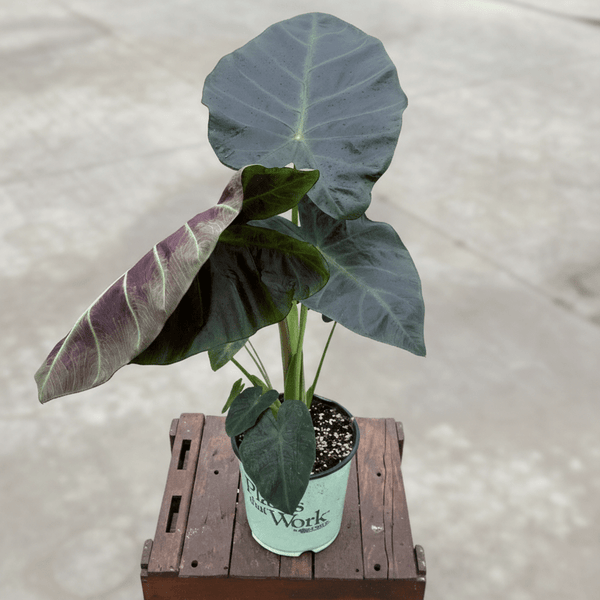
elephant ear plant habitat Aloha Elephant Ear | Tropical Container Plant
SKU: 93956422255
elephant ear plant habitat

elephant ear plant habitat Aloha Elephant Ear | Tropical Container Plant

Sale price$18.20 Regular price$20.22
Save 10%

Pay in installments of $5.05 with ShopPay, AfterPay and Klarna

Shipping Estimate
USA
  • USA
  • CAN

Ships within 48 hours · Estimated delivery Jun 29 - Jul 4

Promo Codes Available:

For Your Every Summer RSVP, with Code: SUMMER15

Description

elephant ear plant habitat Aloha Elephant Ear | Tropical Container PlantAloha Elephant Ear (Colocasia esculenta 'Aloha') brings the drama of the tropics to your garden with bold, oversized leaves that instantly transform any space into a lush paradise. This stunning cultivar produces glossy green foliage that can reach 2 feet long, held on sturdy stems that create a dense, architectural clump. Whether you're looking to add tropical flair to a shaded border, create a statement in a container, or accent a water feature,

Aloha Elephant Ear (Colocasia esculenta 'Aloha') brings the drama of the tropics to your garden with bold, oversized leaves that instantly transform any space into a lush paradise. This stunning cultivar produces glossy green foliage that can reach 2 feet long, held on sturdy stems that create a dense, architectural clump. Whether you're looking to add tropical flair to a shaded border, create a statement in a container, or accent a water feature, Aloha delivers fast-growing impact from late spring through fall.

Tropical Beauty That Thrives in Moisture

Colocasia species are native to wetland areas of Asia and have been cultivated for thousands of years for their edible corms (the well-known taro). The 'Aloha' cultivar brings that same vigorous growth habit to the ornamental garden, with foliage that emerges fresh and glossy throughout the season. The leaves naturally shed water in sheets, a fascinating adaptation that keeps the plant healthy in rainy conditions. In warm climates, you may even see the plant produce cream-colored spathes that resemble calla lilies, though the real show is the foliage.

Versatile Garden Uses

Plant Aloha Elephant Ear along pond margins where its roots can access consistent moisture, or use it to anchor mixed containers where its bold leaves contrast beautifully with fine-textured annuals. The plant works equally well in shaded woodland gardens, tropical-themed borders, or as a specimen in large decorative pots flanking entryways. In zones 8-11, plants will return reliably each spring once established. In cooler zones, grow as an annual or dig the corms in fall and store them indoors like dahlias.

Low-Maintenance Tropical Impact

Once established with consistent moisture, Aloha Elephant Ear practically grows itself. The fast growth rate means you'll see substantial size within weeks of planting, and the plants continue to produce new leaves throughout the summer. Deer and rabbits typically avoid the foliage due to calcium oxalate crystals in the leaves. The plant's water-loving nature makes it forgiving in areas where other tropicals might struggle with humidity or occasional overwatering.

This is the plant that makes neighbors stop and ask questions. The sheer size and exotic appearance of elephant ear foliage creates a focal point that anchors garden beds and containers with bold, confident style.

Shipping Notes
  • Free Standard Shipping on $100+ Orders to the USA.
  • Except Preorder products are shipped in 48 hours.
  • Delivery to the USA:
  1. Standard Shipping : 3-10 business days
  • If time is of the essence, please consider selecting expedited delivery for faster service.
Exchange/Return Notes
  • We offer a 30-day return/exchange service after receiving.
  • Final sale items are not eligible for returns or exchanges.
  • To process your return/exchange, please contact us at [email protected]
  • Please click here for more details>>> Return & Exchange Policy
SKU: 93956422255

Discover Niche Categories That Outsell elephant ear plant habitat

Top-Converting Item to Boost Your Average Order

4.6 ★★★★★
Based on 2174 reviews
Sort
Highest Rating
Newest First
Oldest First
Product Reviews
K
Verified Purchase
Kryptonian
Battle Creek, US
★★★★★ 3
Sometimes Size Does Matter
Scent: Alpine & Spice, Scent: Alpine & Spice
Let me just get this out of the way now the soap itself smells decent, nothing wrong there. I only wish I got another cent. Not that this one smells bad it’s just it wasn’t my cup of tea. I’m mostly disappointed about the size because I’ve been through this before. The soaps themselves are not big enough to fill out the box as you can spot in some of the pictures and video. I honestly feel like the soap size was different in the pictures of the customer reviews that I saw. Each bar may last me a week and a half and that’s with a soap saver. To be honest, the box that it came in would fit two decent size soaps if they filled out the box.
WAS THIS REVIEW HELPFUL?YesReportShare
Reviewed in the United States on November 19, 2025
B
Verified Purchase
Brittany
Phoenix, US
★★★★★ 5
As expected
Scent: vanilla orange
Love the scents of this soap. It's gentle on my skin and leaves me clean, fresh and soft.
WAS THIS REVIEW HELPFUL?YesReportShare
Reviewed in the United States on May 28, 2026
S
Verified Purchase
Sea Dog (retired)
Fort Morgan, US
★★★★★ 5
A Comprehensive Balanced History of the Guadalcanal Campaign -- Must Read!
Format: Hardcover
I've read a number of good books on the Guadalcanal campaign, and always thought that "Neptune's Inferno" by Hornfischer was the absolute best. I was wrong. Although Hornfischer does a superb account of the Navy and its travails and triumphs, Inferno doesn't delve deeply into the Marine (and Army) land battles. This book does both. Moreover, it provides a continuous timeline of both, and does so in such a way that the reader better understands both as related actions. For instance, I was never really aware that for the first three and a half months the Americans controlled the seas during daylight, and the Japanese at night (sounds a little like Viet Nam). The November 13 sea battle between Americans and Japanese -- in which US cruisers took on Japanese battleships and two American admirals died -- was in fact a clash of a major last ditch effort by the Japanese to reinforce their troops and destroy Henderson Field, which would have allowed them to control the seas both day and night. By that time there had been multiple bloody battles ashore between the Marines and Japanese, with the balance favoring the Marines, but if the Japanese had wrested control of the airfield and seas that would have been old history. The book includes a good view from the Japanese perspective, and some little known historical tidbets as well, e.g., Guadalcanal received its name from the Spanish home town of a ships officer who accompanied Spanish explorer Don Alvaro Medana, who discovered the island during a 1568 expedition to discover the fabled King Solomon's gold mines. Who knew? :-) Bottom line: I highly recommend this book, both for its balanced coverage of the entire campaign, land and sea, and even more for its integrated narrative -- you know what was taking place (or had taken place) on almost a day-by-day basis, which allows the reader to fully appreciate how actions ashore influenced those at sea, and vice versa. IMO, a must read, even for those who thought (like me) that they knew it all!
WAS THIS REVIEW HELPFUL?YesReportShare
Reviewed in the United States on October 12, 2017
J
Verified Purchase
Jeffrey T. Munson
Bozeman, US
★★★★★ 5
The Island Of Death
Format: Hardcover
On August 7th, 1942, American Marines stormed ashore on Guadalcanal. What lay before them was a six-month odyssey of fighting against the best of what the Japanese had to offer. In this fine book, author Joseph Wheelan describes the battle that turned the tide in the Pacific War. The Japanese had started construction of an airfield on Guadalcanal. If completed, Japanese aircraft would be able to harass American convoys and threaten Australia. The Americans seized the airfield and eventually, planes from the Cactus Air Force began attacking the Japanese. Throughout the book, the reader learns about all phases of the Guadalcanal campaign, including the battles of Alligator Creek and Bloody Ridge. On the sea, the Americans and Japanese slugged it out at Savo Island, as well as the great naval battles of November, 1942. Names such as Chesty Puller, John Baslone, "Archie" Vandegrift, Joe Foss, and "Bull" Halsey became household names in the United States. Each side lost many men, ships, and planes, but the tenacity and, finally, the industrial might and the ability to rapidly replace losses, led the Americans to victory. Never again would the Japanese regain the offensive in the Pacific War. "Midnight in the Pacific" is a very good book, and the author has done a good job of describing all of the main points of the battle. Each chapter is broken down into a single month's worth of action, and the narrative is well-written. Highly recommended.
WAS THIS REVIEW HELPFUL?YesReportShare
Reviewed in the United States on September 25, 2017
L
Verified Purchase
Laurence J. Rusiecki
Grantham, US
★★★★★ 4
Good Narrative History
Format: Hardcover
The account of the Guadalcanal campaign was well-written. It has several good maps but it falls short with the two carrier battles associated with the action. There should have detailed maps for the Battle of the Eastern Solomons and the Battle of the Santa Cruz Islands. Aside from this shortcoming, the book provides an excellent, readable history of a crucial confrontation between the US and Japan.
WAS THIS REVIEW HELPFUL?YesReportShare
Reviewed in the United States on April 7, 2019

recommand products